Barrels Used For Scotch Whisky Production
Scotlands distilleries do not use new and selfmade barrels for their whisky production.
Rather they buy and take used oak casks (casks are not used more than three times).
The casks have been used prior i.e. for the making of Bourbon, Rum, Port or Sherry.
So the total lifespan of a cask can be 2-3 years for the Bourbon whiskey storage
plus three times more from 12 to 20 years and up for Scottish whisky production.
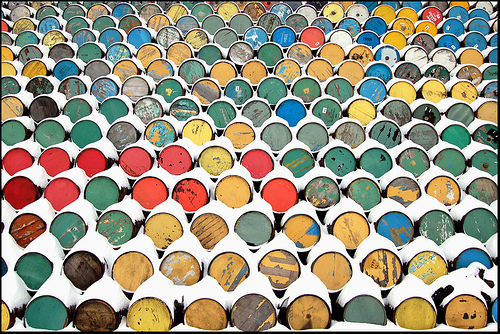
This beautiful photo called "Cold Mountain" was taken by Tim Rogers.
Please click onto the photo to see more of Tim's phantastic pictures!
These used oak casks are available in different sizes and flavor types:
| Name: |
Butt |
Hogshead |
Barrel |
Quarter |
Octavel |
| Contents (liter):
| 500 |
305-250 |
191-173 |
159-127 |
68-45 |
| Cask Used For: |
Color And Flavor Of The Whisky: |
| Sherry |
golden color and light sweet flavor |
| Bourbon |
light, pale color and light vanilla flavor |
| Port / Rhum |
experimental, not used for mass production |
Alcohol Measurement
Vol.% vs. British Proof vs. American Proof
|
Old whiskies coming from Scotland may use as measurement unit for the
content of alcohol the British Sikes Proof (not longer used since
some years). But the British Proof is neither equivalent to the
American Proof nor to the volume % of alcohol (Gay Lussac).
For example:whisky with 40% (vol.) will be 80 Proof (American) but 70 Proof (British).
| Europe: |
%Vol. |
40 |
43 |
46 |
50 |
53 |
57 |
60 |
100 |
Factor is 1.00 |
| U.K.: |
Proof |
70.00 |
75.25 |
80.50 |
87.50 |
92.75 |
99.75 |
105.0 |
175.0 |
Factor is 1.75 |
| USA: |
Proof |
80 |
86 |
92 |
100 |
106 |
114 |
120 |
200 |
Factor is 2.00 |
Japanese Alcohol Classification System
by courtesy of Mr. Kazuo Yoshida
|
1.Background
It used to be mandatory that all alcoholic drinks were classified as
"Class-Special","Class-1" or "Class-2"
by the Liquor Tax Law in Japan,
until it was abolished in 1990.
(I am not very sure when this rule started because bottles produced in early 1970's
do not have this notation, so I suppose it started in late 1970's or beginning 1980's).
Tax was charged depending on this classification respectively, like "800 yen
for a Class-S bottle, 500 yen for a Class-1 bottle and 200 yen for a Class-2
bottle" etc. (the yen amont here is not real).
The classication was determined by the alcohol percentage, and "Class-S"
had higher percentage, while "Class-2" had the lowest. Typically, "Class-S"
whisky contained 43%, "Class-1" 40% and "Class-2" 39% of alcohol.
2.Classification Examples
For example I just picked up some from Suntory items:
Class-S: Suntory Royal and Suntory Special Reserve
Class-1: Suntory Rawhide
Class-2: Suntory Red
Several items sold over the "regulation change in 1990" have two types
of labels: one with the classification notation, and another without.
Please remember that this was the domestic taxation rule, and therefore this
classification was no way stated in English on labels, but only in Japanese.
3.Notation on Labels
Here I show what the notation on the labels looks like (in Japanese characters):
This law was of course applied to the imported liquors as well, so all
Scotches and Bourbons imported before 1990 have this notation on the
"Importer's Label", or sometimes on the main label.
|
"whisky" (no classification)
bottles with this notation were produced
after 1990 (or before mid 70's)
|
|
"whisky class-S"
bottles with this notation were produced
between mid 1970's and 1990
|
|
"whisky class-1"
bottles with this notation were produced
between mid 1970's and 1990
|
|
|
"whisky class-2"
bottles with this notation were produced
between mid 1970's and 1990
|
|
|
|